Guide · Herbalism 101
Beginner Materia Medica: Twelve Herbs, Honestly Rated
8 min read · 1752 words
Pure Herbal Wisdom — Herbalism 101, Module 6
Most herbal references give you a plant and a list of things it is good for. This one gives you a plant, a claim, and how strong the evidence is for that specific claim — because the single most useful habit in herbalism is rating the claim, not the herb.
Ginger is the clearest demonstration. Its research on nausea is genuinely solid. Its research on blood-thinning interaction is real but unsettled. Same plant, two claims, two completely different evidence pictures. Any source that gives you one verdict for the whole herb has thrown away the information you actually needed.
The nine fields, and why each exists
Every herb below is described the same way, in the same order:
| Field | Why it is there |
|---|---|
| Botanical identity | Common names are ambiguous; genus and species are not |
| Plant part used | Different parts of one plant can have completely different safety profiles |
| Preparation | Which extraction method actually reaches the compounds |
| Traditional use | Honestly presented, as a starting signal rather than proof |
| Confidence Scale rating | The four-tier evidence label, applied per claim |
| Dosage context | Ranges reported in research — never a personal prescription |
| Safety profile | The full five-category checklist, run every time |
| Quality and sourcing | Adulteration risk is a real and separate failure mode |
| Related Deep Dive | Where the full investigation lives |
None of these are arbitrary. Skip botanical identity and you risk misidentification. Skip plant part and you risk the elderberry problem below. Skip the Confidence Scale and you are back to trusting headlines.
The twelve at a glance
| Herb | Species | Part | Best-evidenced claim | Tier | Standout flag |
|---|---|---|---|---|---|
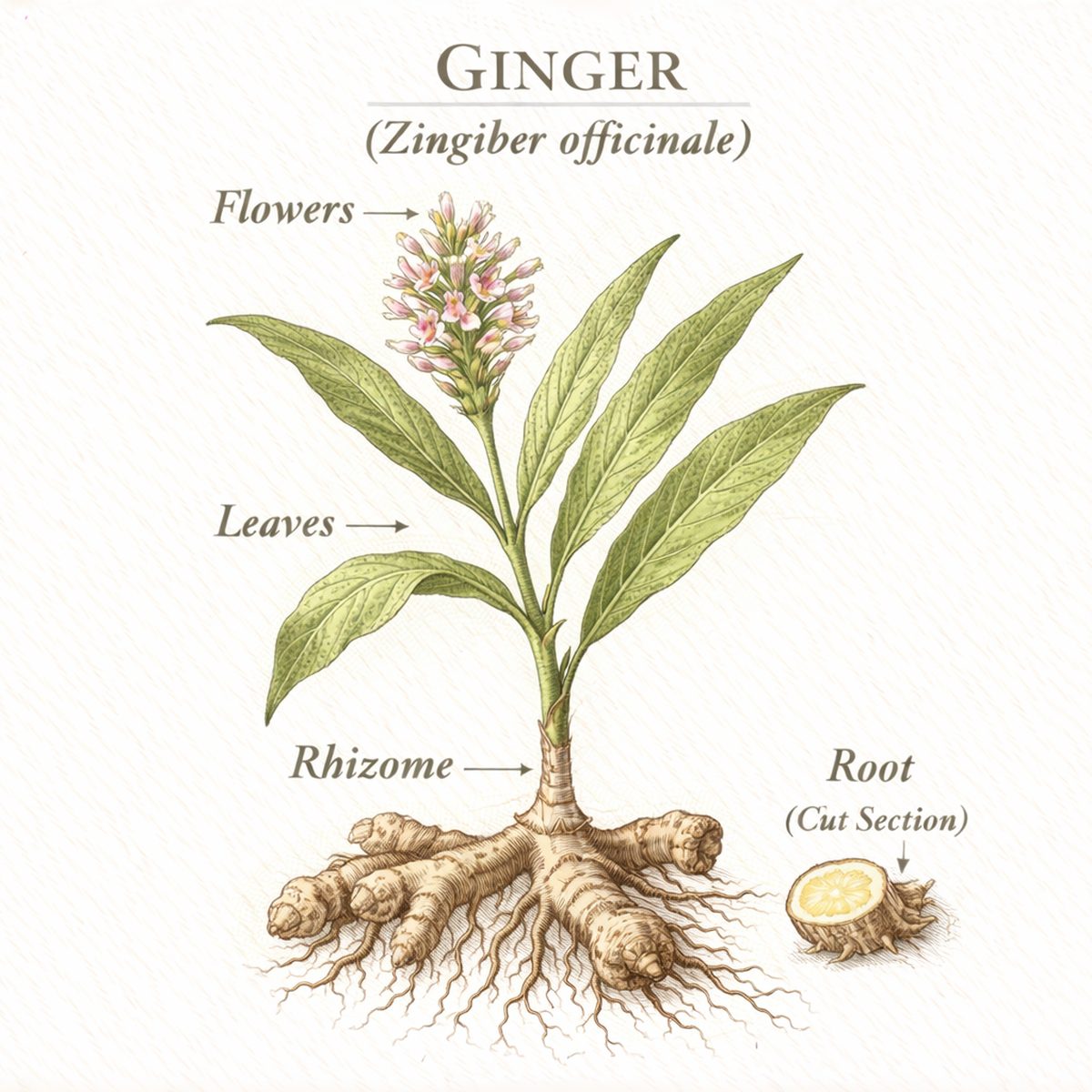
| Ginger | Zingiber officinale | Rhizome | Nausea and vomiting | Moderate–Strong | Blood-thinning medication |
| Turmeric | Curcuma longa | Rhizome | Osteoarthritis pain | Moderate | Piperine-enhanced products and liver injury |
| Garlic | Allium sativum | Bulb | Cholesterol | Moderate | Stop 7–10 days before surgery |
| Elderberry | Sambucus nigra | Ripe berry, processed | Cold duration and severity | Moderate | Raw berries, bark, leaf, root are toxic |
| Ashwagandha | Withania somnifera | Root | Stress, anxiety, cortisol | Moderate–Strong | Thyroid conditions and medication |
| Hawthorn | Crataegus spp. | Leaf, flower, berry | Exercise capacity in heart failure | Moderate | Additive effects with cardiac drugs |
| Echinacea | E. purpurea mainly | Aerial parts, root | Shortening a cold already underway | Moderate | Autoimmune conditions |
| Black seed | Nigella sativa | Seed | Blood sugar, lipids, blood pressure | Moderate | Three separate drug-interaction pathways |
| Milk thistle | Silybum marianum | Seed | Liver enzyme markers | Moderate | Asteraceae allergy cross-reactivity |
| Ginseng | Panax ginseng, P. quinquefolius | Root | Fatigue | Moderate | Makes warfarin less effective |
| Burdock | Arctium lappa | Root | — | Emerging | Documented adulteration poisoning |
| Cinnamon | C. cassia, C. verum | Bark | Fasting glucose | Preliminary–Moderate | Coumarin load in cassia |
Note what that table does not show: a single herb rated Strong outright. The honest top of this range is Moderate-to-Strong, on specific claims.
Four patterns worth more than any single profile
"Interacts with blood thinners" is not one fact pattern
This is the most useful thing in the whole module. Garlic and black seed can increase bleeding risk — garlic through its effect on bleeding time, black seed through thymoquinone's antiplatelet activity. Both should be stopped before scheduled surgery, garlic seven to ten days ahead, black seed at least two weeks.
Ginseng runs the opposite direction. A randomised, placebo-controlled trial found American ginseng significantly decreased peak INR and warfarin blood levels versus placebo — the proposed mechanism being that ginsenosides induce liver enzymes that clear warfarin faster, before it can do its job. Physicians are specifically advised to ask about ginseng use when prescribing warfarin.
One phrase, two opposite dangers. Anyone who tells you "herbs and blood thinners don't mix" has compressed away the part that matters.
Pharmacokinetic and pharmacodynamic are different questions
Hawthorn shows this cleanly. A controlled study combining hawthorn extract with digoxin for three weeks found no significant change in digoxin's blood levels — a pharmacokinetic question, which hawthorn passed. Clinicians still advise caution combining them, because both act on the heart through different mechanisms, and combining two things that each affect cardiac function is a pharmacodynamic question. That is why hawthorn may have additive effects with digoxin, nitrates and blood pressure medication despite the clean blood-level result.
The family you are in can be the risk
Milk thistle and burdock both belong to Asteraceae — the same family as ragweed, daisies and chamomile. Documented cross-reactivity means people with ragweed or related pollen allergies can react, from rash and itching through to rare anaphylaxis. That is not toxicity and not a drug interaction. It is a completely separate risk axis, explained entirely by family membership.
Sometimes the danger is not the herb
The most instructive safety case in this module involves burdock, and burdock did nothing wrong. A published case report describes burdock-root tea poisoning caused by adulteration with a tropane-alkaloid-containing plant — a different, toxic root that resembles burdock closely enough to end up in a commercial product by mistake. Symptoms matched classic tropane alkaloid poisoning.
That is misidentification and product-quality failure, documented, in a real product. For burdock specifically, sourcing matters more than almost any other field.
Where species labelling is a safety decision
Cinnamon. Cassia — the common, inexpensive cinnamon in most spice racks — contains roughly 2–5 mg of coumarin per gram, far more than Ceylon. The European Food Safety Authority's tolerable daily intake for coumarin is 0.1 mg per kilogram of body weight. Do the arithmetic and one to two teaspoons of cassia daily can exceed that for many adults, while the same amount of Ceylon typically would not. Case reports link high cumulative cassia coumarin intake to real liver toxicity. At supplement-level doses, checking which species you have is a quantifiable safety decision, not a connoisseur's preference.
Elderberry. The ripe berry, cooked or properly processed, is the well-studied preparation. Raw or unripe berries — along with bark, root and leaves — contain cyanogenic glycosides, notably sambunigrin, capable of releasing hydrogen cyanide in the body. This is a hard rule rather than a caution: never eat raw or unripe elderberries, and never use bark, leaf or root without expert guidance.
Ginseng. Panax ginseng and Panax quinquefolius are both used and studied, and the distinction is worth checking on a label.
Echinacea. Several species, most commonly E. purpurea, with aerial parts and root used differently depending on preparation.
Where "better absorption" cuts both ways
Turmeric deserves its own note because the tradeoff is counterintuitive. Curcumin alone is poorly absorbed orally — which is part of why it has traditionally been considered safe even at high doses. Piperine, from black pepper, changes that: as little as 20 mg can increase curcumin's bioavailability roughly twenty-fold.
More compound reaching your system means potentially more benefit — and more exposure than curcumin's traditional safety profile was ever tested against. A growing number of case reports, including a ten-case series published through the Drug-Induced Liver Injury Network, have linked turmeric supplements, especially high-bioavailability and piperine-containing formulations, to documented liver injury.
That is a recent and evolving signal, not a settled panic point. But it means the label detail most people skip — whether an absorption enhancer is present — changes the dose you are actually taking.
Where the same herb gets two different answers
Echinacea is the clearest case. "Does echinacea work?" is really two questions.
- Prevention: Preliminary. A large Cochrane review covering 24 trials and over 4,600 participants found no statistically significant effect across prevention comparisons.
- Treating a cold already underway: Moderate. Research, particularly on aerial-part preparations, shows more consistent evidence for reduced duration and severity.
Its proposed mechanism involves stimulating T-cell activity — which is exactly why it is generally advised against for people with autoimmune disorders or conditions such as multiple sclerosis, or used only under direct medical supervision. Worth knowing separately: echinacea has been shown to increase blood caffeine levels by as much as 30%.
Garlic splits the same way — cholesterol at Moderate, blood pressure closer to Preliminary-to-Moderate. Same herb, same cardiovascular theme, genuinely different evidence strength per claim.
The two best-evidenced, and the one that is not
Ashwagandha is the clearest real example of the formal adaptogen definition in this course. Recent meta-analyses found statistically significant reductions in perceived stress scores, anxiety scores and morning cortisol against placebo, typically at 300–600 mg daily over 8–12 weeks. Its flag is endocrine: documented thyroid-hormone effects including case-level reports of thyrotoxicosis, plus case reports of liver toxicity with prolonged or excessive use.
Hawthorn has an unusually good safety dataset for a cardiac-active herb. The 2008 SPICE trial followed 2,681 heart failure patients on 900 mg daily for two years and found no excess of liver, kidney or cardiovascular adverse events versus placebo, and a Cochrane review across 14 trials found hawthorn users reported adverse events at a lower rate than placebo.
Burdock is the honest counterweight. Its rating is Emerging — genuine anti-inflammatory, antioxidant and hepatoprotective activity, but almost entirely from in vitro and animal work, with the literature specifically lacking standardised dosing and robust randomised human trials. Including it at Emerging rather than quietly promoting it is the point of having a scale at all.
A note on dosage
Every profile reports dosage context — ranges that appeared in the research — and none of it is a personal prescription. Research ranges describe what was studied, in whom, in what preparation. They are not instructions, and no dosage here is offered as a blanket recommendation for any reader.
The full lessons
- How to Study a Materia Medica Entry — Lesson 31
- Ginger · Turmeric · Garlic — Lessons 32–34
- Elderberry · Ashwagandha · Hawthorn — Lessons 35–37
- Echinacea · Black Seed · Milk Thistle — Lessons 38–40
- Ginseng · Burdock · Cinnamon — Lessons 41–43
Next: herbal safety, sourcing, and when to consult a clinician.
Medical disclaimer: This content is for educational purposes only and is not medical advice. Consult a qualified healthcare provider before using any herb, especially if you are pregnant, nursing, giving herbs to a child, taking prescription medication, or managing a health condition.